
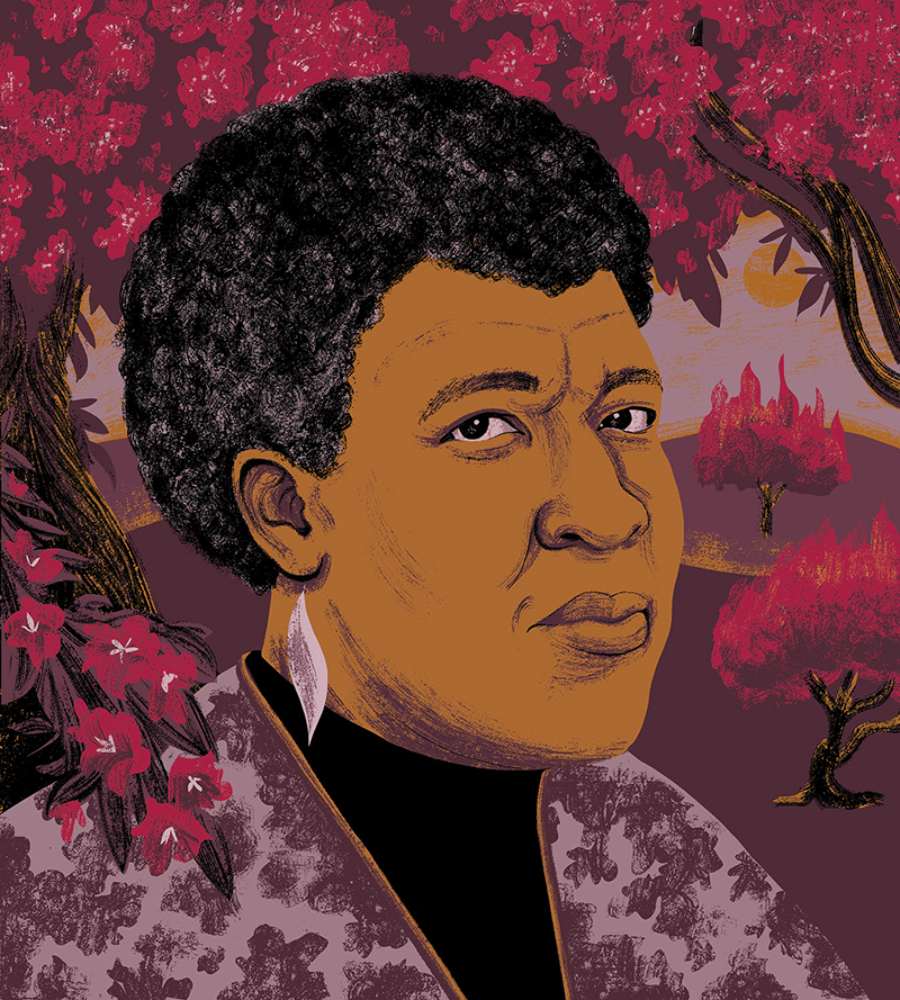
(photo credit: Chloe Cushman for Harper’s Magazine)
I debated about posting this, since this piece is actually an essay, not a formal book (although it has been turned into a print book that I picked up last week from my local library).
However, I decided to go along with reviewing once I read the text and got a feel for how it resonated with me. Sometimes the most profound reading experiences come in small packages. Octavia Butler’s essay “A Few Rules for Predicting the Future,” originally published in Essence magazine in May 2000, is one of those compact pieces that demands to be read, reread, and deeply contemplated during those moments when the world feels most uncertain.
Butler opens with a simple but striking premise: science fiction writers don’t predict the future -they offer warnings disguised as entertainment. I’d read this perspective of hers before many years ago – during Donald Trump’s first term as president, when I read Parable of the Sower for the first time. I was immediately blown away at how fitting the story was for what was at that time, the current moment, and even more so when I realized the book had been written nearly 30 years prior. Writing from her perspective as the acclaimed author of the Parable series, Butler dismantles the myth of the prophetic writer while simultaneously demonstrating exactly why her own “predictions” have proven so unnervingly accurate.
Her approach is both humble and revolutionary. Rather than claiming special insight, she presents prediction as a practice of careful attention to patterns already visible in the present. This perspective feels especially relevant for academics like myself, who must constantly balance immediate demands with long-term planning for our families and careers.
The rules themselves
Butler’s rules are deceptively simple yet profoundly challenging:
- – Learn from the past: She emphasizes studying history not as static facts but as repeating patterns of human behavior. Her observation that “the past, for example, is filled with repeating cycles of strength and weakness, wisdom and stupidity, empire and ashes” (p. 19) should resonate with anyone trying to understand our current political circumstances.
- – Respect the Law of Consequences: Every action creates reactions, often unintended ones. Butler provides an example of medicine with side effects serves as a metaphor for how policies and social changes ripple through systems in unpredictable ways.
- – Be aware of your perspective: Perhaps most importantly, she warns against the limitations of our own viewpoints. As academics, we often operate within disciplinary silos that can blind us to broader patterns and possibilities, and as subject matter experts in our fields, we can often fall prey to the folly of overestimating our own intelligence. This was a humbling, but necessary reminder to do avoid both as often as I can.
- – Count on surprises: I love that Butler takes a moment to remind us that so little of what happens to us in life is actually determined by choices that we make on our own. Yes, we have control over some things, though it likely isn’t as absolute as we might think. She tells us that, “no matter how hard we try to foresee the future, there are always surprises” (p. 53). So what, then, is the purpose of trying to make predictions at all? Her answer is that doing so allows us to give warning when we see ourselves drifting into dangerous territory, and to point out safer or wiser courses of action.
Hope as methodology
In fact, what strikes me most powerfully about Butler’s essay is her insistence that the act of looking ahead – of trying to discern possibilities and offer warnings – is itself an act of hope. This reframing transforms prediction from passive fortune-telling into active resistance against worst-case scenarios.
For those of us raising children in this increasingly uncertain world, Butler’s perspective offers both comfort and challenge. She suggests that our attempts to prepare for multiple futures, to build resilience into our families and work, represent forms of practical optimism rather than anxiety. And that’s something I and my Zoloft prescription can get behind.
Contemporary resonance
Reading Butler’s essay in 2025, her observations about increasing social problems, environmental degradation, and political instability feel less like predictions than like documentation. Her warning about the dangers of ignoring obvious trends while hoping they’ll resolve themselves speaks directly to our current climate and political crises.
Her emphasis on consequences particularly resonates with my work in education. Butler’s insight that we often ignore the “unintended consequences” of policies because “the potential benefits are great” (p. 33) offers a framework for examining how educational reforms often create new problems while attempting to solve old ones. It feels like we as Americans are so short-sighted in our views on the best ways to go about enacting change in our systems. Often, we cannot even come to a consensus about what the goal even is before we begin implementing changes that we have no idea whether or not they’ll be effective.
I volunteer for the Columbus City Schools Board of Education as a community representative for the Equitable and Transparent Resource Management committee. As part of this role, I attend monthly meetings where I have the privilege of interacting with the superintendent and other high-level executives in the school system. I’ve learned so much over my tenure with this committee in the last year, especially about how funding and resource allocation works. Probably the most salient thing that I’ve learned over this time period is how little anyone on the outside seems to understand about how these systems work.
I’m thinking now about protests I’ve watched over the last two years surrounding the school board’s decision to close and merge schools for cost-effectiveness, and about how parents and politicians alike have celebrated Ohio’s “school choice” plans that create pathways for students to attend any private or charter school they’d like. No one seems to realize that these two things are related, that Ed Choice has created unsustainable burdens on the financial solvency of the school board, and that in order to maintain operations at all, some hard choices are having to be made (of course, Ed Choice is just one of many mechanisms bankrupting public education in Ohio, but we can talk more in depth about that later on down the road).
As Americans, we have a tendency to be incredibly, stupidly hyper-individualistic. We are less concerned about what’s good for the whole community, and more concerned about what’s good for ourselves. What not enough of us seem to realize, however, is that focus on the self over the whole has some serious consequences attached, and those consequences ripple throughout the very fabric of our society.
Night owl breakdown:
Scholarly depth: ⭐⭐⭐⭐⭐
Despite its brevity, the essay offers sophisticated frameworks for understanding social change, historical patterns, and the relationship between present actions and future outcomes.
Intellectual freshness: ⭐⭐⭐⭐⭐
Butler’s approach to prediction as pattern recognition rather than mystical insight remains innovative and applicable across disciplines. It continues to amaze me how, even nearly 20 years after her passing, her work continues to become more and more timely and relevant by the day.
Prose clarity: ⭐⭐⭐⭐⭐
Clear, accessible writing that makes complex ideas immediately comprehensible – Butler has a knack for speaking truth to power in ways that are both overwhelming in their insightfulness and instantly understandable, no matter your education or experience level.
Research utility: ⭐⭐⭐⭐⭐
Essential reading for anyone studying social change, speculative fiction, Afrofuturism, or the intersection of literature and social prediction. I mean, pretty much everything she’s written about has come to pass in some form or another, and this essay is her blueprint for *how* she is able to make such inspired and insightful predictions (or rather, observations) about the world around us.
Final verdict?
⭐⭐⭐⭐⭐ All-Nighter
The wrap-up
“A Few Rules for Predicting the Future” serves as both methodology and manifesto. Butler’s rules for prediction double as guidelines for engaged citizenship and thoughtful parenting. In our current moment of rapid change and uncertainty, her emphasis on pattern recognition, consequence awareness, and hopeful vigilance feels more necessary than ever.
I read this essay several times during my own quiet hours, surrounded by the sleeping household I’m trying to help navigate an uncertain future. Butler’s words remind me that prediction isn’t about certainty – it’s about preparation. Her final insight that we can “exert a great deal of influence over this child, even though we can’t control it absolutely” (p. 55) speaks to both societal change and the daily work of raising children in challenging times.
This brief essay packs more wisdom about futures thinking than many academic volumes. It’s essential reading for anyone trying to balance hope with realism, individual action with systemic change, and present responsibilities with future possibilities.
If you’d like to read Octavia’s essay (and I wholeheartedly recommend that you do), you can find a version of it here, via the Common Good Collective. Feel free to leave me a few comments below on your thoughts on the essay (or on Octavia in general – I mean it when I say that I stan this woman!).

 Quiet Hour Critiques