
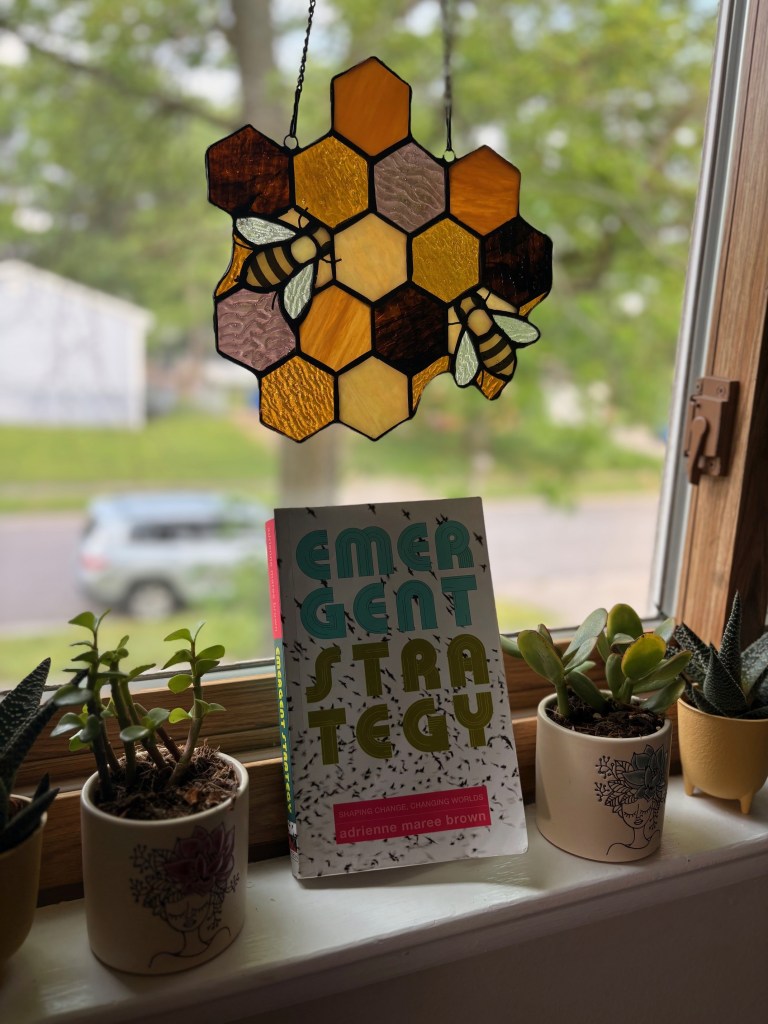
In those precious quiet hours when the house finally settles, sometimes I reach for books that bridge my academic work with my lived reality as a parent and scholar. adrienne maree brown’s “Emergent Strategy: Shaping Change, Changing Worlds” is exactly this type of transformative read— one that kept me awake not from exhaustion, but from excitement about reimagining how change happens.
In Emergent Strategy, brown presents an iterative framework that encourages us as readers to intentionally foster change in ways that expand our capacity for creating just and liberated worlds. She argues that the systems under which we currently live (namely capitalism, but also every other form of systemic oppression) are both unsustainable and (by design) do not allow for people to live up to their full potential. Then, she leverages the visionary examples provided through afro-futuristic works and lessons learned through her own lived experiences as a professional facilitator and mediator in social justice organizing spaces to craft a framework for what she describes as a better way – possibly the only way – forward. brown’s answer to the societal ills that currently plague us, including hyper-individualism, discrimination, poverty, and stagnation, is to imagine a future full of infinite possibilities where the only requirements for movement are respect, imagination, and a willingness to build consensus. We only have to be brave enough to begin.
Beyond traditional frameworks
brown defines emergent strategy as “a strategy for building complex patterns and systems of change through relatively small actions and interactions” (p. 6). Drawing inspiration from the science fiction genius of Octavia Butler (brown’s favorite author, who also happens to be mine) and natural systems, she presents a compelling alternative to the hierarchical organizational models that feel increasingly inadequate in our current moment.
What struck me most profoundly was brown’s assertion that “we must make liberated futures irresistible” (p.15). In my own experience raising children in an uber-capitalistic society that proves daily how little it values the human beings comprising the capital, I’ve felt the weight of trying to create change within systems that seem designed to resist it. brown’s framework offers a different path – one that recognizes how small, intentional actions can create complex patterns of transformation.
Intersectionality meets action
The book’s exploration of interconnectedness, adaptability, and fractals provides rich theoretical grounding while remaining remarkably accessible. Unlike many academic texts that separate theory from practice, brown weaves together concepts from social justice organizing, natural sciences, and speculative fiction into something both intellectually rigorous and immediately applicable. I actually read this book for the first time last summer, before starting my Ph.D. journey, at the encouragement of a kind stranger I met in an airport on my way home from a brief stay in Iceland. I recall being struck by the approachability and immediate applicability of brown’s words to my life and way of operating – it was as if she’d gone inside my head and written my own thoughts and ideas on the page for everyone else to see. Even now, a year on, her words continue to strike the same reverent chords with me.
brown’s emphasis on “critical connections over critical mass” (p. 7) particularly resonates with my experience as an academic and as a parent. The relationships we build – with colleagues, students, our children – often matter more than grand gestures or institutional positions. This insight has profound implications for how we approach both scholarship and social change.
Pedagogical implications
From my perspective in workforce development education, brown’s framework aligns beautifully with constructivist, connectivist, and humanistic learning theories. Her approach supports student-centered teaching environments that honor learners’ agency in articulating their own futures—something desperately needed in our current educational landscape.
The iterative concepts outlined in the book also challenge educators to move beyond filling students with prescribed concepts and skills toward building learning environments that nurture partnership and leadership. This shift from compliance to critical consciousness feels essential, particularly for those of us working with historically marginalized populations. She writes about having the feeling that we as a society are on the precipice of some great change – of remaking the world as we know it. That thought is both terrifying and liberating. I feel it, too – in my work, in my interactions with people around me, in everything that I touch. brown’s words inspire me to be hopeful and optimistic rather than fearful, and to understand that as a teacher and facilitator, it is my charge to help light the way, guiding the next generation of learners and doers into whatever the next chapter looks like for humanity.
The power of imagination
Perhaps the book’s greatest strength lies in its insistence that imagination is not frivolous but essential for survival. Contemporary adulthood often requires that we abandon imagination and whimsy in exchange for practicality and safety, but this is not only stifling, it is unhelpful for really living an authentic and liberated life. As someone trying to model possibility for my own children while navigating academic institutions, this framing of imagination as resistance feels both necessary and hopeful.
Night owl breakdown
Scholarly depth: ⭐⭐⭐⭐
While not explicitly academic, Emergent Strategy offers sophisticated frameworks that translate beautifully into educational theory and practice. brown’s integration of multiple disciplines creates rich opportunities for analysis, and her plain language and disarming approach make this text feel do-able… something sorely lacking in many of the more complex academic pieces I’ve read.
Intellectual freshness: ⭐⭐⭐⭐⭐
brown’s skillful synthesis of biomimicry, science fiction, and social justice organizing brings genuinely innovative perspectives to discussions of change and organizing. Many times in reading this book, I found myself highlighting, making notes, and stopping to look up people or works she referenced for further research – and I learned about some excellent new scholars along the way whose work I am now delving into as I continue shaping my own academic identity.
Prose clarity: ⭐⭐⭐⭐⭐
brown employs accessible and engaging writing that makes complex concepts immediately comprehensible, even during those late-night reading sessions when mental energy is low. This is a book that I read for the first time in just a couple of days, and have since reread several times, both for its insights and the comfort of the conversational tone.
Research utility: ⭐⭐⭐⭐
Though brown herself is not an academic (a point she makes clear more than once in the text), her work is incredibly valuable for scholars examining organizational change, educational theory, social justice pedagogy, and community organizing. The framework of emergence translates across disciplines beautifully – I’ve even had the pleasure of practicing the principles of the book this summer during co-design sessions with the Women+ of Color Equity Design Institute at Zora’s House! Certainly having familiarity with brown’s work and the concepts of emergence made that experience so much more fruitful for me as a scholar and co-designer.
Final verdict?
⭐⭐⭐⭐ Late Night Essential
The wrap-up
Emergent Strategy reminded me why I decided to pursue a Ph.D. in the first place – not just to analyze the world, but to help create better versions of it. brown’s vision of change as natural, adaptive, and community-centered offers a much-needed alternative to the competitive individualism that pervades so many institutional spaces.
For fellow academics reading this during your own quiet hours, brown’s work offers both intellectual stimulation and practical wisdom for navigating the complex work of raising children while trying to create more just systems. Her reminder that “there is nothing new under the sun, but there are new suns” (another great quote from the incomparable Octavia Butler – p. 88) captures the hope that keeps many of us working toward transformation, one small action at a time.
I cannot recommend this book enough.

 Quiet Hour Critiques