
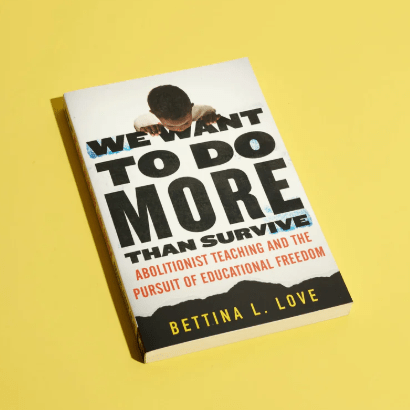
Some books demand to be read almost immediately upon discovery, not because they’re easy escapes, but because they fundamentally challenge how you see your work and world. Dr. Bettina Love’s “We Want to Do More Than Survive: Abolitionist Teaching and the Pursuit of Educational Freedom” is exactly this type of necessary disruption. Love delivers a blistering critique of the current American educational system and its relationship to systemic racism, white supremacy, and all kinds of oppression. Published in 2020, during a time of heightened awareness around racial injustice, her book is perhaps even more relevant in the current moment, hers is a book that should be required reading for anyone working in education.
Abolitionist teaching as revolutionary practice
Love’s central thesis is both simple and radical: the American educational system was designed to maintain white supremacy, and surface-level reforms will never address deeply embedded inequities. Instead of spinning our wheels trying to retrofit equity into a system that was never designed to support learners of varying backgrounds and experiences, she advocates for “abolitionist teaching” – a complete reimagining of education through frameworks that prioritize liberation over compliance.
Her distinction between “surviving” and “mattering” particularly resonate with my perspectives on workforce development. As Love writes, “We who are Dark want to matter and love, not just to survive, but to thrive. Matter not for recognition or acknowledgement, but to create new systems and structures for educational, political, economic, and community freedom” (p. 1). This reframing challenges us to examine whether our programs truly foster thriving or merely help people navigate oppressive systems. She heartily critiques diversity initiatives that focus solely on representation without addressing power structures or engaging with the lived experiences of marginalized communities and, in doing so, highlights how policies developed without intersectional frameworks inevitably fail to address the complex realities of the very people they purport to serve.
The Educational Survival Complex
Love’s concept of the “educational survival complex” – encompassing standardized testing, character education programs, and compliance-based curricula – provides a crucial analytical framework. Her critique extends beyond traditional public schools to include charter schools like KIPP that emphasize “grit” and individual overcoming rather than systemic change. She argues that these mechanisms function to maintain racial hierarchies rather than to genuinely educate children, and she views character education as especially problematic, contending that “students no longer learn how to be informed and active citizens… instead, they learn how to comply and recite affirmations about their grit” (p. 70).
This analysis has profound implications for workforce development, where similar logics often prevail. Too often, our programs focus on preparing individuals for existing economic structures that encourage competition and rampant individualism rather than supporting students’ rights to self-determination and self and collective advocacy. This portion of the book, for me, was especially resonant, as I often think about the challenges facing neurodivergent individuals who often experience difficulty when expected to assimilate into the traditional capitalist workplace with little to no regard for their own needs or desires.
Theory as a liberation tool
One of the book’s strongest contributions is Love’s insistence that “theory gives us the language to understand and fight oppressions” (p.132). Drawing on critical race theory, Black feminism, Quare studies, and critiques of settler colonialism and neoliberalism (something I’ve been researching more and more this summer), she provides analytical tools that feel essential for current political moments.
Love’s emphasis on intersectionality moves beyond representation to examine “community power (or its lack), and ensuring inclusivity in social justice movements” (p. 3). This perspective has direct relevance for parents who often navigate multiple, sometimes conflicting identities and responsibilities. Indeed, as someone navigating academia while raising three Black children in middle America myself, I deeply appreciated Love’s integration of personal narrative with theoretical rigor. Her autobiographical elements ground abstract concepts in lived reality, making the work both more accessible and more urgent.
The book’s focus on building coalitions across difference feels particularly timely as diversity, equity, and inclusion initiatives face increasing backlash. Love’s call for allies to have “skin in the game” rather than merely offering performative support provides crucial guidance for sustainable change work. in fact, Love rejects the idea of allyship altogether – instead she argues that what we actually need are co-conspirators.
Freedom dreaming
Perhaps most importantly, Love grounds her critique in “freedom dreaming” – the radical imagination of new possibilities based on a critical understanding of injustice (p. 101). This isn’t merely aspirational but also practical, offering concrete examples of abolitionist teaching through teacher strikes, student activism, and curricular resistance.
For those of us working within imperfect systems while trying to create change, Love’s framework provides both inspiration and strategic guidance. Her vision reminds us that if we are to remake the world in a more just and equitable way, then our daily work – whether in classrooms, research, or parenting – can (and must) be sites of resistance and transformation.
Night owl breakdown:
Scholarly depth: ⭐⭐⭐⭐⭐
Sophisticated theoretical frameworks combined with practical applications. Love’s synthesis of multiple critical theories provides rich analytical tools for understanding systemic oppression.
Intellectual freshness: ⭐⭐⭐⭐⭐
While not an entirely new concept (as Mother Octavia has taught us, there is nothing new under the sun, after all), Love’s framing of and advocacy for abolitionist teaching offers genuinely innovative approaches to educational transformation, moving beyond the same tired reforms centrists have tried to put into practice for years toward fundamental, radical reimagining of the ways in which we educate in America.
Prose clarity: ⭐⭐⭐⭐
In this text, Love gives us accessible writing that successfully integrates personal narrative with theoretical complexity. Though it can be occasionally dense with critical theory terminology and examples that seem to repeat the same concepts ad nauseum, it is well worth the intellectual effort to power through.
(And, if you happen to be a person whose lived experiences do not mirror those of Love, her emphasis on these concepts may feel less repetitive to you.)
Research utility: ⭐⭐⭐⭐⭐
This book is a vanguard in liberation studies. It is essential reading for scholars in education, workforce development, critical race studies, and anyone examining the relationships between schooling and social justice.
Final verdict?
⭐⭐⭐⭐⭐ All-Nighter
The wrap up
“We Want to Do More Than Survive” arrived at a crucial moment in my own development as both scholar and parent. Love’s unflinching analysis of educational systems challenged me to examine my own complicity while offering frameworks for more liberatory practice.
The book’s insistence on moving beyond incremental reform toward abolitionist transformation feels both daunting and necessary. For academics and parents alike, Love’s work offers both analytical tools and moral clarity for the complex work of raising children while trying to create more just institutions.
Her reminder that “students no longer learn how to be informed and active citizens, which is key to democracy” (p. 70) should haunt anyone involved in education – especially as we are witnessing the current coordinated efforts by those in political power at all levels to rewrite history and erase the very values and liberties that are essential to the way we function as a free society. This book kept me awake not just because of its powerful arguments, but because of its urgent call to action. In this moment, we need Love’s vision of education as a site of resistance and possibility more than ever.
What books have fundamentally challenged your assumptions about your professional practice? Share your transformative reads in the comments below!

 Quiet Hour Critiques